
Every decision you make comes with risk.
It could be small, like testing out a new restaurant, or large, like crossing a road without traffic lights.
Risk is also an important financial planning consideration, especially when it comes to investing. The more risk you take, the more opportunity you give your wealth to grow.
If you are nervous about investment risks, you could be “risk-averse”. This is the tendency to prefer a certain, low-risk outcome to a riskier option, even if the potential reward from the high-risk choice is much greater.
Keep reading to learn more about how risk aversion and an overreliance on cash could impact your financial plan, and three ways a planner can help you overcome your psychological barriers to investing.
Risk aversion can cause you to play it safe with your money
Risk aversion can play an important role in investing. According to one Aviva study, 39% of Brits are put off investing altogether because they think it is too risky.
Investing gives your wealth the opportunity for more substantial growth. Yet invested wealth may also be vulnerable to short-term market setbacks. This fact can deter many from investing altogether. Instead, they may favour safer alternatives, including cash, even though returns could be lower.
That is not to say that risk aversion is inherently bad. An appropriate degree of caution can help you achieve the right balance of risk in your portfolio. Otherwise, you could be drawn to high-risk investments, such as cryptocurrency, or fail to carefully diversify your portfolio.
Holding too much cash could limit your financial future
Cash has its place in your financial plan when it comes to fulfilling short-term needs, such as:
- Everyday costs, like bills and groceries
- Annual holidays
- Emergency repairs, like fixing a broken roof.
But there can be such a thing as too much cash.
Cash savings could limit how much your wealth can grow. At the time of writing, Money Saving Expert claims that the best easy-access cash savings rates are between 4.5% and 5%. On the other hand, the S&P 500 has produced average annual returns of around 10% over all the years it has existed, Fidelity reports.
Cash is also more vulnerable to inflation, which can slowly erode its value.
In fact, according to AJ Bell data, inflation has outpaced average growth from Cash ISA savings since the accounts were introduced in 1999 up to the end of July 2026 (note that Cash ISA returns are based on average interest rates available at the time).
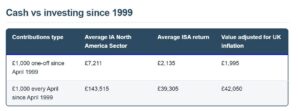
Source: AJ Bell
In both scenarios, investments held in an average IA North America index-tracking fund significantly outperformed inflation. However, the Cash ISA only failed to keep pace with inflation in the regular contribution example.
Although past performance is not a reliable indicator of future performance, these figures suggest that investing may give you a greater chance of beating inflation than cash.
3 ways financial planning can help you overcome your risk aversion
Risk aversion can prevent you from reaching your financial aims. Learn three ways a financial planner can help you overcome this challenge and invest with confidence.
1. Explaining investment options in plain language
According to the same Aviva study referenced above:
- 33% of non-investors say it is because they do not know enough about investing
- 23% lack the confidence to begin investing and do not know where to start
- 16% find it complicated.
Much of the anxiety about investing comes from a lack of knowledge or a misunderstanding of investing principles.
A financial planner can explain investment options in plain language and consider which are most suited to your personal situation and ambitions.
A deeper understanding of how your wealth is invested, the level of risk it is being exposed to, and what your potential gains might be could help you feel more confident. And if you are ever unsure, you can simply speak to your financial planner for clarity.
2. Building a diversified portfolio
Certain investment strategies help you mitigate the amount of risk that your wealth is exposed to.
Diversification is the process of purchasing investments of various asset types in different geographical locations and markets. That way, if one of your investments in a specific market suddenly falls, another might rise, potentially reducing the impact of losses on your overall portfolio.
A financial planner can tailor a bespoke portfolio with diversified assets to help balance investment risk and long-term growth potential with your unique circumstances and aims.
While a financial planner cannot guarantee your investments will be safe from short-term setbacks, a diversified portfolio spreads risk so you can weather volatility with confidence.
3. Acting as a sounding board during periods of volatility
Risk aversion can be most apparent during periods of market volatility when investments suddenly rise or fall in value.
When market volatility causes your investments to lose value quickly, it might trigger a knee-jerk reaction in which you sell them to prevent further losses.
In reality, market volatility is a normal part of investing, and movements happen every day. History tells us that if markets fall, they usually recover given time. Therefore, selling your investments in response to volatility could only crystallise your losses and mean missing out on growth during the subsequent recovery.
A financial planner can guide you through periods of volatility and help you stay calm and measured so you do not make a decision that works against your objectives.
Get in touch
If you think you might be risk-averse and want this mindset to stop limiting your financial plan, speak to a member of the DBL Asset Management team today.
Email enquiries@dbl-am.com or call 01625 529 499 to speak to us today.
Please note
This blog is for general information only and does not constitute advice. The information is aimed at retail clients only.
All information is correct at the time of writing and is subject to change in the future.
The value of your investments (and any income from them) can go down as well as up and you may not get back the full amount you invested. Past performance is not a reliable indicator of future performance.
Investments should be considered over the longer term and should fit in with your overall attitude to risk and financial circumstances.
Cryptoassets are not regulated financial products so please be aware that trading them carries a considerable amount of risk for your capital. Cryptocurrencies are also not covered by existing consumer protection laws and are not suitable for the majority of investors.