
Image rights can be a lucrative income source for rugby players. You might license your image for use in sponsorships and advertising campaigns, public appearances, or even video games.
Our recent article about how rugby players can use image rights to boost financial security will tell you everything you need to know.
However, the rules regarding the tax treatment of income from licensing your image are changing from 6 April 2027.
This could mean you pay more tax on these earnings. More importantly, your responsibilities and the way you manage this income will change, and if you are not on top of the new rules, you could make costly mistakes.
Read on to learn more about the changes and how they could affect you.
The tax treatment of image rights earnings depends on how you receive the income
If you license your image to an organisation, including your own club, the tax treatment of the earnings will differ depending on how you receive them.
They could be paid directly to you, as a self-employed individual, by a company. This might happen if you give a company the rights to use your image. In this case, you would declare the earnings through Self Assessment and likely pay Income Tax and National Insurance contributions (NICs) on them.
You might also give an employer (most likely your current club) the rights to use your likeness. Here, your earnings would be treated in the same way as your salary and subject to Income Tax through Pay As You Earn (PAYE). This means Income Tax and NICs are deducted automatically.
However, there is a third option, which many professional rugby players take advantage of. You could receive your earnings through an image rights company.
The company has permission to license your image, and it receives any earnings from doing so. You can then extract wealth from the company as and when you choose. Crucially, the income will be taxed differently if you receive it through an image rights company.
Earnings received through an image rights company may be subject to Corporation Tax, Income Tax, and Dividend Tax
The tax implications of using an image rights company can be complex because multiple taxes could apply.
First, the company itself will have to pay Corporation Tax on profits. This is charged at 19% on profits up to £50,000 and 25% on profits exceeding £250,000. Between £50,000 and £250,000, marginal relief is applied, effectively creating a sliding scale of tax from 19% up to 25%.
Depending on your tax bracket, Corporation Tax could be significantly lower than the Income Tax and NICs you would have paid had you received the earnings directly. Also, the image rights company can claim deductible expenses to reduce its Corporation Tax bill.
You must also consider how you draw wealth from the business. You might pay yourself a salary, which would be subject to Income Tax and NICs. Alternatively, you could take dividends (a share of the company profits paid to shareholders), which have their own specific rate of tax.
Both Income Tax and Dividend Tax rates depend on the tax bracket the earnings fall into.
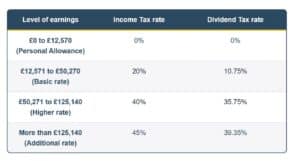
As you can see, dividends are taxed at a lower rate than your salary. While you may pay Corporation Tax on your earnings and then Income Tax or Dividend Tax when you eventually extract the wealth, an image rights company could give you more flexibility.
For instance, you might leave earnings tied up in the business during your playing career, when you are likely to be in a higher tax bracket. Then, when you retire from playing and your earnings fall, you could draw from the image rights company.
Alternatively, you might spread withdrawals across several tax years to make efficient use of the Dividend Allowance, which allows you to draw £500 in dividends each year without paying tax.
These are just a few examples of how an image rights company provides you with more tax planning opportunities. With the support of a professional, you could structure your earnings and plan withdrawals from the image rights company in a way that reduces the tax you pay.
From 6 April 2027, earnings from an employer will be treated as part of your salary for tax purposes
Under the current rules, earnings you receive from licensing your likeness can be paid through an image rights company, including those from a club you play for.
This means that many rugby players and other professional sportspeople have dual contracts with a club:
- A playing contract through which they are employed by the club.
- A separate image rights agreement made with a company owned by the player.
HMRC are changing the rules around this specific arrangement from 6 April 2027.
New rules, first announced in the 2025 Budget, specify that image rights payments relating to employment are considered earnings. This means that, even if the funds are paid to an image rights company, they are treated as earnings.
So, you will pay Income Tax and NICs on the funds right away, and the club will pay NICs, too. This could significantly increase the tax bill for both you and your club.
3 ways you can prepare for the change
You still have until 6 April 2027 before the rule change takes effect. In that time, there are simple steps you can take to prepare.
1. Review your existing image rights agreements
First, make sure you are clear about all the different agreements you have with your club as well as other organisations.
It is important to understand the agreements you have with your club so you can consider how the changes might affect your tax liability.
Additionally, after the rule change, you may need to prove to HMRC that certain image rights deals are not part of your employment and should be treated as such for tax purposes. There could be some grey areas if promotions are associated with the club in some way but paid for by a third party. So, make sure you have clear records of all agreements in case you need to provide evidence.
2. Consider the changes in future negotiations
Clubs will be affected by the change because they will pay NICs on payments for image rights. This increases their costs, and they may take this into account when negotiating future contracts.
It is important to be aware of this and consider that clubs might reduce your playing salary slightly to account for their higher costs.
3. Seek professional advice to understand your tax affairs
Tax legislation is complicated, and when rules change, it is easy to make mistakes. That is why you may benefit from professional advice so you can understand the tax treatment of different income sources and how best to structure your arrangements.
Please do contact DBL Asset Management for support today.
Email enquiries@dbl-am.com or call 01625 529499 to speak to us today.
Please note
This article is for general information only and does not constitute advice. The information is aimed at individuals only.
All information is correct at the time of writing and is subject to change in the future.
Please do not act based on anything you might read in this article. All contents are based on our understanding of HMRC legislation, which is subject to change.
The Financial Conduct Authority does not regulate tax planning.