
If you have carried out any research at all concerning your financial future, you may have come across two savings options: pensions and Individual Savings Accounts (ISAs).
Both can play a key role in your financial planning, offering tax advantages that make each an attractive vehicle for saving and investing.
Deciding how and when to contribute to these is sometimes portrayed as a binary, “either-or” choice.
In reality, it is important to appreciate that both are key parts of your financial planning, so it is more a question of prioritisation than choosing one or the other.
How you prioritise will depend on key issues, including the options that each provides, as well as your personal objectives and long-term plans.
ISAs provide you with tax efficiency and financial flexibility
The simple process of saving money will be a key ongoing part of your financial management.
You will want to set money aside for a variety of reasons. These could include:
- Short-term objectives, such as buying a new car or saving for a holiday
- Longer-term planning, including saving a deposit for a property
- Building a fund that you can draw on in an emergency.
Additionally, you may just want to grow your wealth and enjoy the peace of mind that comes with having a substantial sum set aside.
Whatever your reason, it is important to consider the taxation aspects of saving and investing. You could be liable for tax on:
- The interest you accrue on your savings
- Profits you make from your investments
- Income from dividends on those investments.
By mitigating the tax you pay on your savings and investments, you can grow your wealth more effectively.
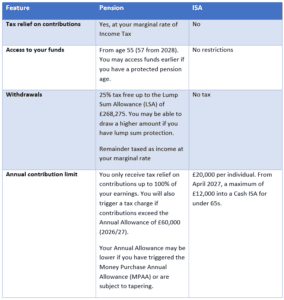
ISAs provide you with significant tax advantages, enabling you to save or invest up to £20,000 each year (2026/27 tax year) without paying Income Tax or Capital Gains Tax on the interest, profits, or dividends. You also enjoy tax-free access to your fund with no restrictions on when you can withdraw your money (aside from the limited restrictions of a fixed-term savings account).
Because of this, it makes sense to maximise your annual ISA entitlement for saving and investing.
The flexibility in accessing your ISAs makes them ideal for short-term savings. The Stocks and Shares ISA option also allows you to enjoy tax-efficient, long-term investment growth and build a pot of money that you can draw on once your “first career” as a professional player ends.
Pensions should generally be prioritised for long-term retirement planning
While your playing career is likely to end in your 30s, you will stop working completely much later than that.
Pension benefits generally cannot be accessed until you reach age 55 (rising to 57 in 2028). In some cases, if you have a protected pension age, you may be able to access your funds earlier.
Because of these limitations, you should see pension saving as a long-term objective and structure your investment strategy accordingly.
The government incentivises pensions with tax relief on all your eligible contributions.
So, for every £80 you contribute, an additional £20 is automatically added as basic-rate relief.
If you are a higher- or additional-rate taxpayer, you can claim back further relief at your marginal rate of Income Tax through your Self Assessment tax return each year.
Your club may offer a pension scheme through which it will match your personal contributions. If this is the case, it is well worth contributing the maximum matched amount to maximise employer contributions.
In this way, with regular contributions and an effective long-term investment strategy, you can grow your wealth during your playing career and build a substantial fund by the time you finally stop working.
Summarising the differences between pensions and ISAs
The following table summarises the benefits of ISAs and pensions and outlines their key differences.
Get in touch
Pensions and ISAs are both likely to be key components of your long-term financial strategy.
We can help you explore this strategy and avoid any mistakes that could harm your overall financial plan.
Email enquiries@dbl-am.com or call 01625 529 499 to speak to us today.
Please note
This article is for general information only and does not constitute advice. The information is aimed at individuals only.
All information is correct at the time of writing and is subject to change in the future.
Please do not act based on anything you might read in this article. All contents are based on our understanding of HMRC legislation, which is subject to change.
The Financial Conduct Authority does not regulate tax planning.
A pension is a long-term investment not normally accessible until 55 (57 from April 2028). The fund value may fluctuate and can go down, which would have an impact on the level of pension benefits available.
The tax implications of pension withdrawals will be based on your individual circumstances. Thresholds, percentage rates, and tax legislation may change in subsequent Finance Acts.
The value of your investments (and any income from them) can go down as well as up, and you may not get back the full amount you invested. Past performance is not a reliable indicator of future performance.
Investments should be considered over the longer term and should fit in with your overall attitude to risk and financial circumstances.